
Blockchain
Events
-
-
Using Rust to Interact with a Hyperledger Fabric Network
Online event***Please Use Source Link Below to Confirm Event Details*** This will be a short overview of ongoing Rust implementations for the Hyperledger Fabric SDK and Rust chaincode. Join me to get an introduction on how to participate on the Rust libraries for Hyperledger Fabric lab. Original Event: Using Rust to Interact with a Hyperledger Fabric Network
Free -
-
Fabric-X – Programming Model and Application Development Deep Dive
Online event***Please Use Source Link Below to Confirm Event Details*** Fabric-X is a digital asset-specific implementation of Hyperledger Fabric. Join us for a series on meetups that go into detail about what Fabric-X is and how you can use it. Fabric-X introduces a new programming model that redefines how business processes are developed on the blockchain. In this session, we’ll take a deep dive into the endorsement phase of Fabric-X, highlighting how it differs from the traditional Hyperledger Fabric model and what these changes mean for developers. Through hands-on examples, we’ll demonstrate how the new model streamlines development and unlocks exciting possibilities for designing decentralized applications. We’ll also explore how to build applications tailored for tokenization use cases, enabling seamless on-chain asset representation and transfer. To close the session, we’ll walk through practical deployment strategies using Ansible and Kubernetes, equipping you with the tools and confidence to bring your Fabric-X solutions into production. Original Event: Fabric-X – Programming Model and Application Development Deep Dive
Free -
-
Fabric-X-Committer: A Microservices-Based Architecture for Ultra-High Throughput
Online event***Please Use Source Link Below to Confirm Event Details*** Fabric-X is a digital asset-specific implementation of Hyperledger Fabric. Join us for a series on meetups that go into detail about what Fabric-X is and how you can use it. Fabric-X-Committer introduces a high-performance and resilient architecture that addresses the scalability limitations of the traditional monolithic peer in Fabric. By decomposing the commit process into independently scalable microservices—including a Coordinator, Signature Verifiers, and Validator-Committers and leveraging a sharded distributed database, the system achieves significant parallelism, enabling substantial scalability and performance gains. A key innovation is the use of a transaction dependency graph, which allows safe, parallel validation of transactions across multiple blocks. Combined with a pipelined execution flow, this design eliminates sequential bottlenecks and unlocks ultra-high throughput. Performance evaluations show that Fabric-X-Committer can process over 200,000 transactions per second, marking a major leap in scalability for enterprise-grade blockchain systems. In this meetup, we will provide an overview of the Fabric-X-Committer architecture and share performance evaluation results that highlight its scalability and efficiency. Original Event: Fabric-X-Committer: A Microservices-Based Architecture for Ultra-High Throughput
Free -
-
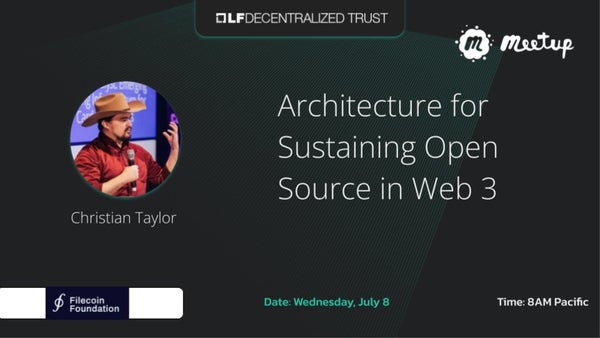
Architecture for Sustaining Open Source in Web 3
Online event***Please Use Source Link Below to Confirm Event Details*** Open source is the foundation of Web3, but most ecosystems still fund it like a series of short-term projects instead of long-term public infrastructure. As decentralized networks grow, the real challenge is no longer just building software. It is maintaining the critical code, tooling, standards, and contributor communities that keep the ecosystem secure, usable, and resilient. This session explores what an architecture for sustaining open source in Web3 should look like. We will examine why traditional grant models often fall short, how maintenance differs from feature delivery, and why decentralized ecosystems need clearer coordination structures without recreating centralized control. The discussion will introduce models such as decentralized OSPOs and open maintenance frameworks as practical ways to align governance, funding, accountability, and contributor support. Attendees will leave with a clearer understanding of how Web3 ecosystems can move from reactive funding toward intentional stewardship of open source infrastructure. Original Event: Architecture for Sustaining Open Source in Web 3
Free -
-
Sacramento Bitcoin & Crypto Monday Meetup
3810 Broadway, Sacramento, CA***Please Use Source Link Below to Confirm Event Details*** We meet every 2nd and 4th Monday of the month at Capsity coworking space in Sacramento. We discuss Bitcoin, crypto, the blockchain, DeFi, economics, Metaverse, NFTs, and more! Our group is pretty advanced but n00bz are always welcome. Whether you are from traditional finance, a VC, a developer, a trader, or a complete novice, all are welcome. Building a project? Let's discuss it. Although quiet, crypto is not dead and this administration is pushing it forward! Past topics have included discussion on: Smart Contracts, Decentralized Systems, and Applications. Blockchain Technology. Technical Trading. On-chain Analysis. Mining. Economics and Politics. Gold, Silver, Money, and other currencies. NFTs and the MetaVerse. Original Event: Sacramento Bitcoin & Crypto Monday Meetup
Free