
Providence Technology Group


State claims there’s zero high-risk AI in California government—despite ample evidence to the contrary
California uses algorithms to predict whether incarcerated people will commit crimes again. It has used predictive technology to deny 600,000 people unemployment benefits. Nonetheless, state administrators have concluded that not a single agency uses high-risk forms of automated decisionmaking technology. That’s according to a report the California Department of Technology provided to CalMatters after surveying nearly 200 state entities. The agencies are required by legislation signed into law in 2023 to report annually if they use high-risk automated systems that can make decisions about people’s lives. “High-risk” means any system that can assist or replace human decisionmakers when it comes to encounters with the criminal justice system or whether people get access to housing, educatio...[Read More]


What escaped cuts during tight state budget year? Government IT projects
As lawmakers wade through a sea of budget cuts and make decisions about which state programs to slim down, several government technology projects managed to avoid the chopping block. Meanwhile, Gov. Gavin Newsomhas proposed paring down other initiatives, like Medi-Cal expansion, to plug California’s $12 billion deficit. Keep Reading This Article at MSN.com
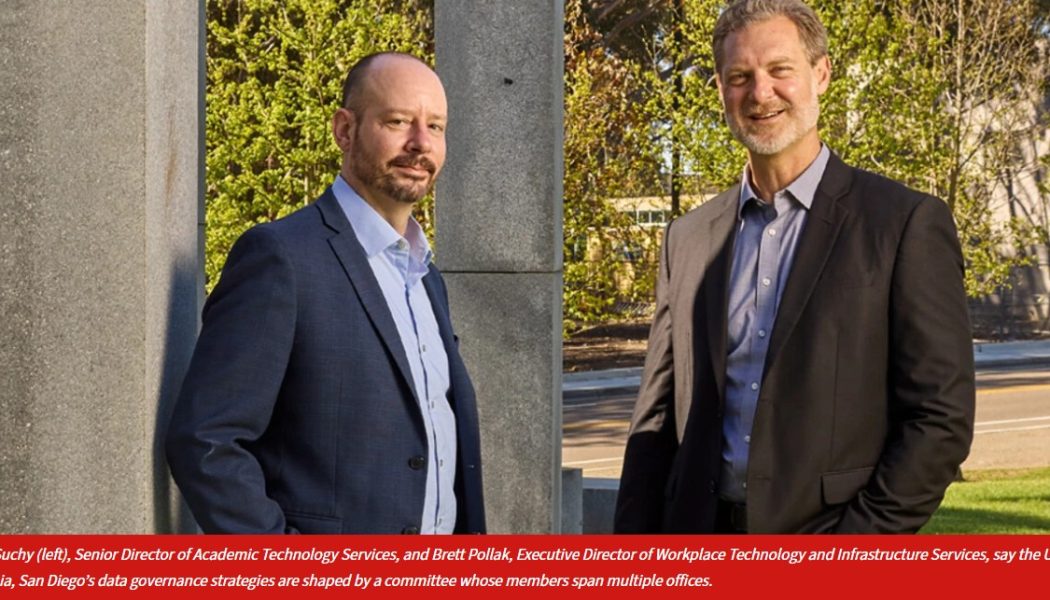

Effective AI Requires Effective Data Governance
As part of its artificial intelligence adoption strategy, the University of California, San Diego is leveraging existing data governance practices, but it’s also taking a fresh look at its approach to ensure internal data is properly vetted, used and protected. The university recently built its own suite of generative AI tools, called TritonGPT. One AI assistant being tested will allow staff to use natural language to ask questions and get answers based on institutional data that’s stored in an enterprise data warehouse used for analytics, says Brett Pollak, UC San Diego’s executive director of workplace technology and infrastructure services. Keep Reading This Article at EdTech Magazine


Mental Health and Substance Misuse Treatment Is Increasingly a Video Chat or Phone Call Away
More Californians are talking to their therapists through a video screen or by phone than in person, marking a profound shift in how mental health care is delivered as record-setting numbers seek help. While patients and providers say teletherapy is effective and easier to get than in-person services, experts in the field noted that teletherapy often requires a skilled mental health practitioner trained to pick up subtle communication cues. Almost half of the roughly 4.8 million adults who visited a medical professional for mental health or substance use disorders in 2023 did so exclusively through teletherapy, according to a KFF Health News analysis of the latest data from UCLA’s California Health Interview Survey. Keep Reading This Article at KFF Health News


Air Force picks Beale to host CCA drone wingmen ‘aircraft readiness unit,’ begins ground testing
The US Air Force announced today it has selected Beale Air Force Base in California to host the service’s first “Aircraft Readiness Unit” dedicated to its future fleet of drone wingmen. The drones, dubbed Collaborative Combat Aircraft (CCA), have also begun ground testing ahead of a first flight expected this summer, the Air Force said in a press release. “Starting ground tests is a key milestone for the CCA Increment 1 program,” Air Force Chief of Staff Gen. David Allvin said in the release. “This phase bridges the gap between design and flight, reducing integration risks, boosting confidence, and laying the groundwork for a successful first flight and eventual fielding to the warfighter.” Keep Reading This Article at Breaking Defense


How Covered California sent patient’s personal health data to LinkedIn
The website that lets Californians shop for health insurance under the Affordable Care Act, coveredca.com, has been sending sensitive data to LinkedIn, forensic testing by CalMatters has revealed. As visitors filled out forms on the website, trackers on the same pages told LinkedIn their answers to questions about whether they were blind, pregnant, or used a high number of prescription medications. The trackers also monitored whether the visitors said they were transgender or possible victims of domestic abuse. (See the data on our Github repo.) Keep Reading This Article at East Bay Times


State and Local Agencies Deploy Artificial Intelligence for Document Processing
In partnership with the county assessor’s office, the King County, Wash., IT team has used artificial intelligence (AI) in a prototype redaction service that can remove sensitive information that may appear in application documents submitted for the senior property tax exemption program. It has worked successfully on 96% of documents, says Director of Data Strategy and Operations Grace Preyapongpisan. The IT office also uses the software to read through documents and populate a database with information on how people have died. Keep Reading This Article at StateTech


How health systems are tackling the rise of ‘shadow AI’
Shadow AI—the use of unauthorized or unmonitored AI tools within organizations—is an escalating concern, particularly in sectors like healthcare where data privacy and compliance are critical. This phenomenon arises when vendors or employees deploy AI tools without the knowledge or approval of an organization’s IT or compliance departments. “Many applications now include AI in some form,” Jason Adams, MD, Director of Data and Analytics Strategy at UC Davis Health told Becker’s. “Often, even the individuals requesting the technology aren’t aware that AI is embedded in the product. It’s an ongoing challenge.” Keep Reading This Article at Becker’s Hospital Review: Health IT


Leave no patient behind: New AI model can help identify patients in need of care management services
Artificial Intelligence is helping UC Davis Health predict which patients may need immediate care and eventually keep them from being hospitalized. The population health AI predictive model created by a multidisciplinary team of experts is called BE-FAIR (Bias-reduction and Equity Framework for Assessing, Implementing, and Redesigning). Its algorithm has been programmed to identify patients who may benefit from care management services to deal with health problems before they lead to emergency department visits or hospitalization. Keep Reading This Article at Medical Xpress


Wexford’s Connect Labs Open at Aggie Square
Connect Labs Sacramento, located at Aggie Square, opened a facility in March designed to support early-stage startups in digital, life science and health sectors. The 50,000-square-foot space features pre-built and furnished labs, office and support spaces with a curated set of amenities, services and shared equipment for emerging and growth companies. “It’s an awesome opportunity for life sciences and health companies building their products, especially those coming out of universities and looking for a place to land,” said Monique Brown, Wexford Science and Technology’s new Knowledge Community Director of Connect Labs. “It’s a huge capital expense to purchase these things on your own, especially when you’re a small company.” Keep Reading This Article at UC Davis


Why Understanding AI Starts With Math
Can you predict whether a passenger would have survived the sinking of the Titanic based on factors like gender and income? How do you know if a mushroom is poisonous or safe to eat? What separates a cancerous cell from a typical one? Students in Clayton Dagler’s machine-learning class at Franklin High School in Elk Grove, Calif. near Sacramento, Calif., puzzle over such complex problems by pairing a computer-coding language commonly used in artificial intelligence technologies with math concepts. Their assignments mirror how professionals increasingly look to AI to inform everything from disease diagnosis to fraudulent credit charges. Dagler developed the course after a short conversation with the parent of one of his students, an Apple executive. Keep Reading This Article at Education We...[Read More]


As AI nurses reshape hospital care, human nurses are pushing back
The next time you’re due for a medical exam you may get a call from someone like Ana: a friendly voice that can help you prepare for your appointment and answer any pressing questions you might have. With her calm, warm demeanor, Ana has been trained to put patients at ease — like many nurses across the U.S. But unlike them, she is also available to chat 24-7, in multiple languages, from Hindi to Haitian Creole. Keep Reading This Article at MSN.com